Wire edm vs sinker edm which is right for you
Rapid Manufacturing
Author
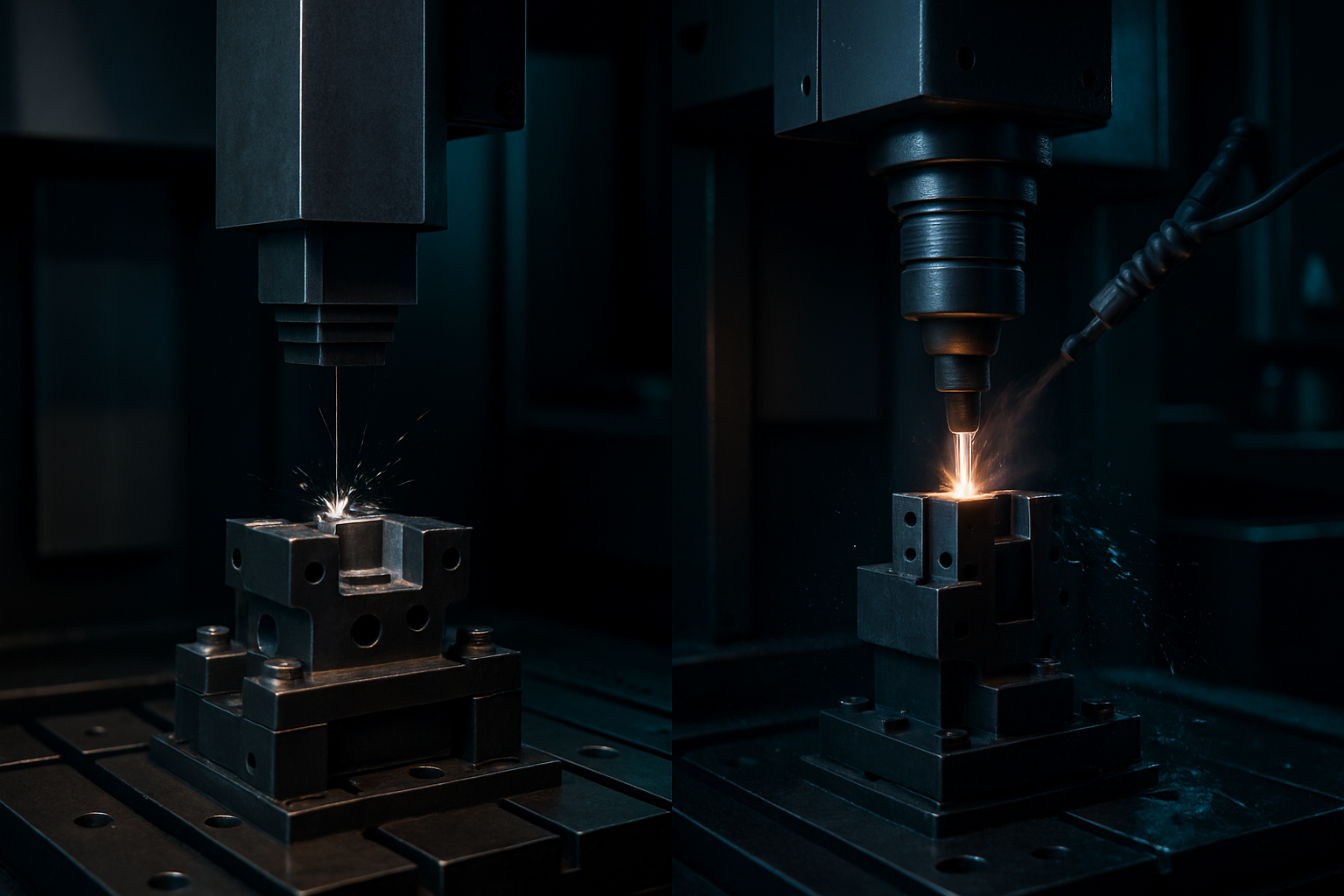
Choosing Between Wire EDM and Sinker EDM: A Guide for Australian Engineers
Electrical Discharge Machining (EDM) is a critical process in precision manufacturing, offering unique capabilities to shape complex geometries that are difficult or impossible with traditional machining methods. In Australia, engineers and procurement managers must choose between two main types of EDM processes: Wire Electrical Discharge Machining (WEDM) and Sinker Electrical Discharge Machining (Sinker EDM). This guide will help you make an informed decision based on the specific requirements of your project.
Understanding WEDM vs. Sinker EDM
Wire EDM
Wire EDM is a subtractive manufacturing process that uses a thin brass wire to cut through electrically conductive materials by creating sparks between the workpiece and the wire. The process is highly accurate, capable of achieving tolerances as tight as ±0.001 mm with surface finishes down to Ra 0.2 μm.
Key Considerations:
- Materials: Ideal for hard metals like hardened steel (HRC45–60), tool steels, and titanium.
- Applications: Suitable for complex geometries such as fine pitch gears, intricate molds, and medical implants.
- Costs & Lead Times: WEDM operations can be time-consuming due to the wire feed process. Expect costs around $120-$300/hr depending on complexity and material hardness, with lead times ranging from a few hours for simple parts up to several days for complex geometries.
Sinker EDM
Sinker EDM, also known as ram EDM or die-sinking EDM, involves an electrode that is shaped in the inverse of the desired final part geometry. The electrode moves through the workpiece, eroding material away by creating electrical discharges between the electrode and the workpiece.
Key Considerations:
- Materials: Effective for tough materials like hardened steel (HRC45–60), carbide, and exotic alloys.
- Applications: Commonly used in die-making, aerospace components, and molds requiring deep pockets or cavities with high aspect ratios.
- Costs & Lead Times: Sinker EDM is generally faster than WEDM for parts that do not require wire feed. However, complex electrodes can be costly to produce (around $150-$300/hr), impacting overall project economics and lead times.
Choosing the Right Process
Decision Framework:
- Choose Wire EDM when: You need tight tolerances (±0.001 mm) or extremely fine surface finishes, and your part geometry is complex with intricate details.
- Choose Sinker EDM when: Your material hardness exceeds HRC50, you have deep cavities or high aspect ratios, or the electrode can be reused for multiple parts.
Common Mistakes to Avoid
- Overlooking material properties: Ensure that chosen materials are compatible with EDM processes and consider their machinability.
- Ignoring cost trade-offs: While WEDM offers tighter tolerances, Sinker EDM might offer faster production speeds for certain geometries. Always evaluate total project costs including electrode production in Sinker EDM.
- Failing to consult experts: Engage with experienced engineers or suppliers who understand the nuances of Australian supply chains and local standards (e.g., AS/NZS 1383 Safety requirements for electrical equipment).
Quick Reference: Key Decision Points
- Material Hardness: HRC45–60 range often determines suitability.
- Geometry Complexity: Intricate details favor Wire EDM; deep cavities suit Sinker EDM.
- Surface Finish & Tolerances: Wire EDM excels in tight tolerances and fine finishes, while Sinker EDM can achieve good results but may require secondary finishing for ultra-smooth surfaces.
- Economic Considerations: Cost of electrode production is critical for Sinker EDM; WEDM wire feed rate impacts overall time-to-market.
Applying What You've Learned
Understanding the strengths and limitations of Wire EDM and Sinker EDM will help Australian manufacturers select the most effective process for their projects. By considering material properties, geometry complexity, surface finish requirements, and economic factors like lead times and cost structures, you can make informed decisions that enhance productivity and product quality.
For further customization or optimization, consult with your local machining experts to tailor these guidelines specifically to your operation's unique needs.
Free quote in 2 business days. No minimum order.