CNC Milling vs Turning Which Process Is Best For Your Part Manufacturing Needs
Rapid Manufacturing
Author
Understanding CNC Milling vs Turning: Choosing the Right Process for Australian Engineers and Manufacturers
Choosing between CNC milling and turning can significantly impact the efficiency and quality of your manufacturing processes in Australia. Both methods are widely used to produce high-precision parts from a variety of materials but serve different purposes, making them suitable for distinct applications.
CNC Milling vs Turning: Key Differences and Applications
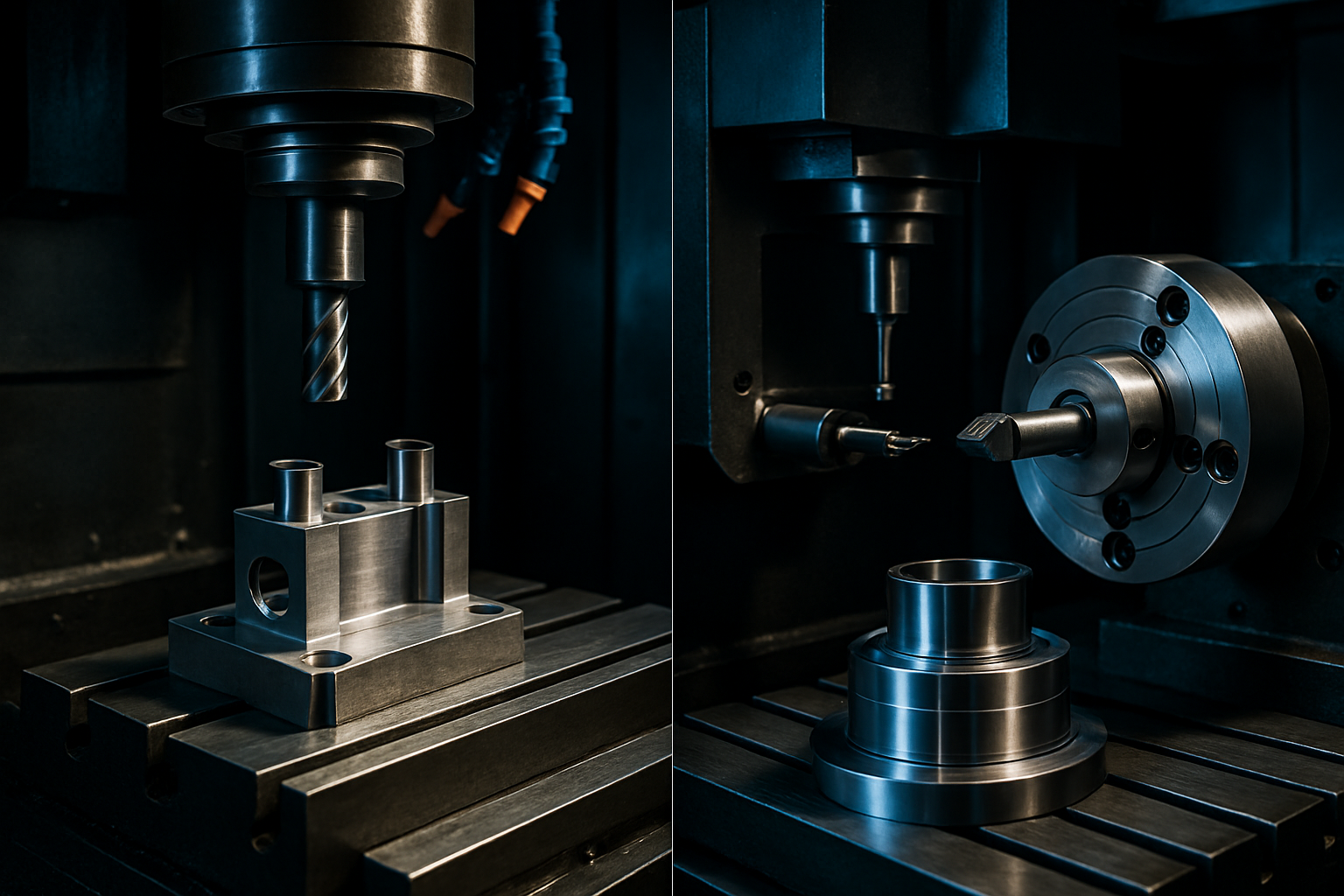
CNC Milling: This process involves rotating a multi-point cutting tool around the workpiece (usually held stationary) to remove material. It can create complex geometries and shapes, including pockets, slots, and threads. Commonly used materials include aluminium, stainless steel, titanium, and plastics like PEEK.
CNC Turning: In contrast, turning involves rotating the workpiece against a single-point cutting tool. This process is excellent for creating cylindrical or conical parts, such as shafts, axles, and screws. It can also produce complex contours on rotational surfaces with precision.
Choosing Between CNC Milling and Turning: Real-World Scenarios
When deciding which method to use, consider the part geometry, material properties, and manufacturing tolerances:
- Geometric Complexity: For parts that require intricate geometries like gear teeth or turbine blades, milling is often more suitable due to its ability to create complex shapes in multiple axes.
- Production Volume: Turning is highly efficient for producing large volumes of identical cylindrical parts quickly. Milling might be preferable when dealing with smaller batches of custom-shaped components.
- Material Tolerances and Hardness: Softer materials like aluminium (6061) can often be milled or turned, but harder materials such as titanium or stainless steel 316L may require specialised tools and slower cutting speeds to maintain tolerances.
Quick Reference: Key Specifications for Choosing CNC Milling vs Turning
- CNC Milling: Complex geometries (pockets, slots), multi-axis machining, suitable for aluminium ($25–45/kg), stainless steel 316L ($70–130/kg).
- CNC Turning: Cylindrical shapes (shafts, axles), contour work on rotational surfaces, efficient for large volumes.
Common Mistakes to Avoid
- Overlooking the impact of material properties: Harder materials like titanium can be challenging for both milling and turning if not properly accounted for in tooling selection.
- Ignoring precision requirements: Ensuring that your chosen process can meet necessary tolerances (e.g., ±0.1mm) is crucial, especially when dealing with critical aerospace or medical components.
- Failing to optimize machine settings: Adjust machining parameters according to material hardness and thickness to prevent excessive wear on tools and machinery.
Decision Framework for Australian Manufacturers
Choose CNC Milling When: You need to create parts with complex geometries, require multi-axis capability, or are working within a smaller production volume that demands flexibility. Choose CNC Turning When: The part design is primarily cylindrical or conical, you aim for high-volume production efficiency, and the material properties allow for efficient turning operations.
Practical Takeaway
Understanding the nuances between CNC milling and turning will help Australian engineers and manufacturers make informed decisions that optimise their manufacturing processes. Whether it's selecting the right process for a new project or refining existing workflows, leveraging these insights can lead to cost savings, improved part quality, and enhanced productivity in your operations.
By carefully evaluating material properties, production requirements, and machining capabilities, you are better positioned to leverage CNC technologies effectively within an Australian context.
Free quote in 2 business days. No minimum order.